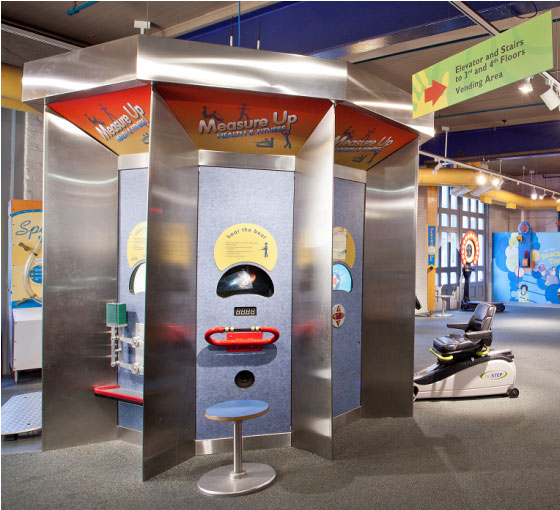
Measure Up

How it works
Visiting each of the eight stations will help you determine how your health and fitness measures up.
- Visit the inches station to see how you measure up in inches.
- Ready to test your health and fitness knowledge? Visit the body facts station.
- Visit the balance, hang time, strong arm, and flexibility stations to test your physical fitness. Can you improve with practice?
- Want to know how many times your heart beats per minute? Visit the hear the beat station.
How do the foods you choose and your level of activity affect your weight? Find out by visiting the calorie scale station.
What's going on?
Understanding how to eat healthy and the benefits of physical fitness is important. Being physically active and eating healthy foods give you more energy, makes you stronger, and helps you maintain a healthy weight. How do you know if what you are doing to become healthier is working for you? That's where fitness tests, like the ones in this exhibit, come in. Measuring your fitness level regularly is one way to find out if you're making progress.
Try this at home!
You have everything you need to measure your fitness level in your own house! Each of the tests below is a timed physical fitness test – invite a friend over and take turns timing each other (isn’t everything more fun with a friend?). Each time you do one of the tests, write down the score so you can keep track of your progress! As long as you are improving, your fitness plan is working.
The Crunch Test
This partial curl-up test measures abdominal strength and endurance.
What you'll need:
- Stop watch or timer
- Lie down flat on your back with your knees bent and your feet on the floor.
- Hold your hands wherever you feel comfortable (on your chest or beside your head - just be sure you don't pull on your head).
- Simply roll your upper torso forward. Do not sit all the way up; this can strain your back.
- Do as many crunches as you can in one minute. You may rest in the starting position, but the clock continues to run.
Stork Balance Stand Test
This tests your ability to balance on the ball of your foot.
What you'll need:
- Flat, non-slip surface (a floor with carpeting for example)
- Stopwatch or timer
- Remove your shoes and place your hands on your hips.
- Decide which leg you will be balancing on. Put your foot against the inside of your balancing leg’s knee (for example, if you are balancing on your right leg, put your left foot on the inside of your right leg’s knee.)
- The stopwatch is started as your foot is placed on your knee.
- The stopwatch is stopped if any of the follow occur:
- Your hand(s) come off your hips.
- Your foot on the floor swivels or moves (hops) in any direction.
- Your foot comes off your knee.
- Rest, and then try the test again balancing on your other leg. Was balancing easier on one leg than the other?
step test
This simple test measures your cardiovascular endurance.
What you'll need:
- Stairs
- Stopwatch or timer
What you'll do:
Step on and off the stair for three minutes.
- Step up with one foot and then the other.
- Step down with one foot followed by the other foot.
- Try to maintain a steady four beat cycle. It's easy to maintain if you say "up, up, down, down". Go at a steady and consistent pace.
- At the end of 3 minutes, remain standing while you immediately check your heart rate. Take your pulse for one minute. To take your pulse:
- Using your index finger and middle finger together, find your pulse either on your wrist or your neck.
- After you find the beat, count how many beats occur within 60 seconds. Or you can take a shortcut – count the number of beats in 15 seconds, and then multiply that number by 4.
wall sit test
This test is a measure of lower body strength endurance.
What you'll need:
- Smooth wall
- Stopwatch or timer
- Stand with feet approximately shoulder width apart, with your back against a smooth wall.
- Slowly slide your back down the wall until both your knees and hips are at a 90° angle (like you’re sitting up straight on a chair, only there isn’t a chair!).
- Lift one foot off the ground.
- The timing starts when one foot is lifted off the ground and is stopped when you put your foot back on the ground.
- Rest, and then try the test again with your other foot lifted off the ground.
In the real world
The Let's Move! project was started by First Lady Michelle Obama in 2010. The goal of the project is to fight childhood obesity and encourage a healthy lifestyle through healthy eating and getting physically active.
Let's Move! recommends that children get 60 minutes of physical activity per day, and adults 30 minutes per day. So turn off the television and put down your video games. Head to the park (take your parents with you!), ride your bike, or just put some music on and dance… get moving!
Ready for a snack? How about reaching for a banana instead of a handful of potato chips?