Infrared Camera

How it works
The light we see with our eyes is only a portion of the light that exists. There are also invisible waves of light, such as ultraviolet, radio, and infrared. Infrared light has very long wavelengths our eyes cannot detect. Objects emit infrared waves at different rates depending on their temperatures. An infrared camera is able to detect these long infrared waves so we can see objects of different temperatures.
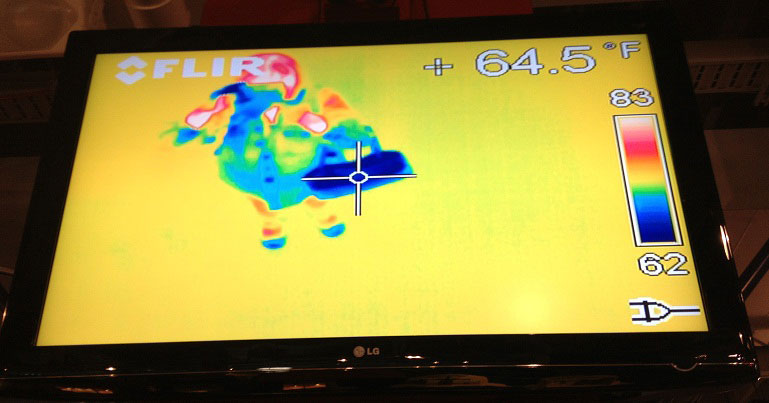
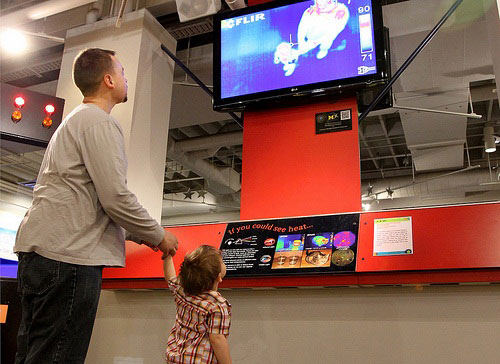
Stand in front of the exhibit, look up. Do you see the monitor? Move until you can see a colorful version of yourself on the monitor. What you see is projected from the exhibit's infrared camera. Different colors represent different temperatures.
You can find out what temperature a color represents by using the color-temperature scale shown on the right side of the screen. The temperature is in degrees Fahrenheit. Notice that your bare skin (like your face) has a higher temperature than parts of your body covered with clothing. Are you holding an object like a backpack? It will have an even lower temperature.
What's going on?
Infrared is a type of light that we cannot see with our eyes. Our eyes can only see what we call visible light. Infrared light brings us special information that we do not get from visible light. It shows us how much heat something has and gives us information about an object's temperature. If we had infrared eyes, we could tell if an object was cold or hot without touching it.
Everything has some heat and puts out infrared light. Even things that we think of as being very cold like an ice cube or a snowball put out some heat. Cold objects just put out less heat than warm objects. The warmer something is the more heat it puts out and the colder something is the less heat it puts out. Hot objects glow more brightly in the infrared because they put out more heat and more infrared light. Cold objects put out less heat or infrared light and appear less bright in the infrared.
Infrared light is only one of the types of light that we cannot see with our eyes. There are many more, such as X-rays, gamma-rays, ultraviolet light and radio waves. Each of these different types of light brings us new information that we cannot get by using our eyes alone.
Try this at home!
What absorbs more heat? When you're out in the sun on a hot summer day you stay cooler if you are wearing lighter colored clothes. Why is that? Experiment with light, color, heat, and some water to find out.
What you'll need:
- 2 identical drinking glasses or jars
- water
- thermometer
- 2 rubber bands
- white paper
- black paper
- a sunny day
- Wrap the white paper around one of the glasses using a rubber band to hold it on.
- Do the same with the black paper and the other glass.
- Fill the glasses with the exact same amount of water.
- Leave the glasses out in the sun for a couple of hours before returning to measure the temperature of the water in each.
What's happening?
Dark surfaces such as the black paper absorb more light and heat than the lighter ones such as the white paper. After measuring the temperatures of the water, the glass with the black paper around it should be hotter than the other. Lighter surfaces reflect more light, that's why people where lighter colored clothes in the summer, it keeps them cooler.
If you put the glasses from your experiment in front of an infrared camera, the glass wrapped with the black paper would be represented by a color higher on the color-temperature scale than the glass wrapped with the white paper.
In the real world
Infrared light can travel through thick smoke and visible light cannot. This allows firefighters to find people and animals in smoke filled buildings. The infrared body heat from people and warm-blooded animals travels through the smoke; they show up clearly through an infrared camera. Also, because infrared light can travel through thick fog, it is very useful to have infrared cameras on ships and airplanes to help in navigation.
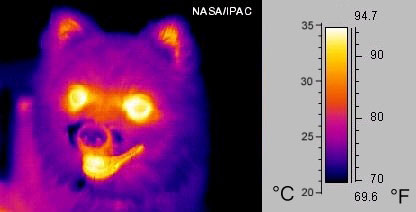
Scientists use infrared cameras to study warm-blooded animals at night and to study how animals use fur, feathers, and blubber to keep themselves warm.
Infrared cameras are also used by satellites in space to measure the temperature of the oceans, and to study the Earth's weather during both the day and night.