Levitator

How it works
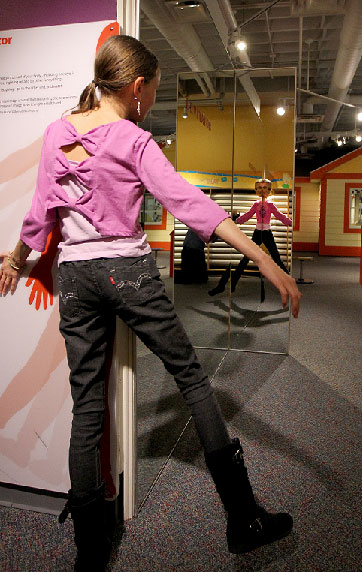
Try this! Stand against the red stripe so that half of your body, including one eye, is on the mirror side. Kick your right leg up and hold it in the air, and do other funny things. When you have stopped laughing, go to the other end, and watch someone else perform. Walk around. Notice that your image stays at the line joining the two mirrors. Wave your right hand. Does your image wave its right or left hand?
What's going on?
A mirror can be any smooth, shiny surface that reflects, or bounces back, light. But most mirrors, like the ones in this exhibit, are made of sheets of glass, the backs of which have been coated with thin layers of reflective materials or metals.
We see all things because light waves reflect off objects and into our eyes, creating images that are recognized by our brains. You can see yourself in a mirror because light rays reflected from your body bounce off the mirror's shiny surface and back into your eyes.
When you kick your right leg up and hold it there, in the mirror it appears that you suddenly leap into the air and float there. Why is this?
You’ve probably noticed that images in a mirror do not look exactly the same as the object. There are two properties of reflected images that account for this particular illusion. The first is the position of the image. The image is not on the mirror but is actually formed behind the mirror. It appears to be as far behind the mirror as the object is in front. The reflected image of the lifted leg appears at about the same position behind the mirror as your other leg would be.
The second property that also helps fool our brain is the orientation of the image. You’ve probably noticed that if you part your hair on the right, your image in a mirror has hair parted on the left side. You may then think that mirrors switch images from side to side but this is not true! If you held an arrow pointing up vertically in front of a mirror, the image in the mirror will also show the arrow pointing up. If you then point the arrow horizontally towards one side of the mirror, the image also points to the same side of the mirror. This tells you that the vertical and horizontal directions of reflected images are unchanged. But a mirror does change something. If you point the arrow directly into the mirror, the image of the arrow points outward in the opposite direction. Or, when we look into a mirror our image looks back at us. A mirror only changes the direction the object is facing into and out of the mirror.
If we apply the above to your lifted leg and the mirror, your leg and its image are both upright because the mirror has not inverted the image. Your foot is pointing in the same way because the mirror has not reversed things from side to side. However, since a mirror does change the direction the image faces, the inside of your leg which would normally face away is now reflected back towards you.
Since the image is in the same position and orientation as your other leg, your brain is convinced that it is making a normal observation. When you lifted your leg the image was lifted and your brain was fooled into telling you that you had lifted both of your legs and had actually floated off the ground.
Try this at home!
What you'll need:
- 3 hand mirrors or pocket mirrors
- Tape
- Small clock
- Book or newspaper
- Take two mirrors and place them together with the shiny sides facing one another. Tape them along the side to form a hinged door. Open the mirrors like a book and set them on a table.
- Face the clock in front of the mirrors.
- Try to tell the time in the mirror.
- Face a page in the book or the newspaper toward the mirrors.
- Try to read the writing in the mirror.
- Repeat steps 2 through 5 using the single remaining mirror.
What's happening?
It was hard to tell the time and read the writing in the single mirror, right? That’s because the single mirror reverses the clock face and the words (like it reverses the side you part your hair on).
Why was it so much easier with the two mirrors taped together? The image in the left mirror is reflected to the mirror on the right and then to your right eye. The image in the right mirror is reflected to the mirror on the left and then to your left eye. The image that actually gets to your eye is correctly oriented instead of reversed.
In the real world
The mirrors in this exhibit are flat mirrors. A flat mirror will give you a realistic image (an image without distortion). Curves in a mirror will distort the image, which is why Fun House mirrors are curved. You probably have a flat mirror hanging in your bathroom or bedroom that you use to see how you look before heading out to start your day.
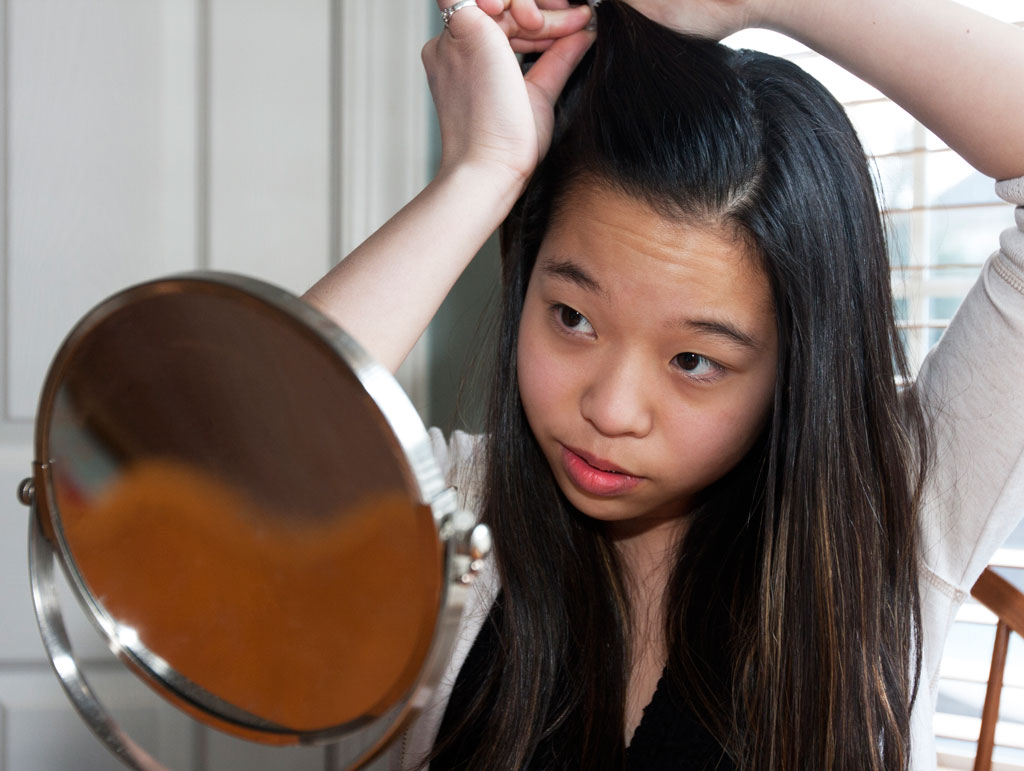
Mirrors are also used in scientific equipment such as telescopes and lasers, and are used in cameras as well. Rear-view mirrors are widely used in and on vehicles (such as automobiles, or bicycles), to allow drivers to see other vehicles coming up behind them.