Blast Off!

How it works
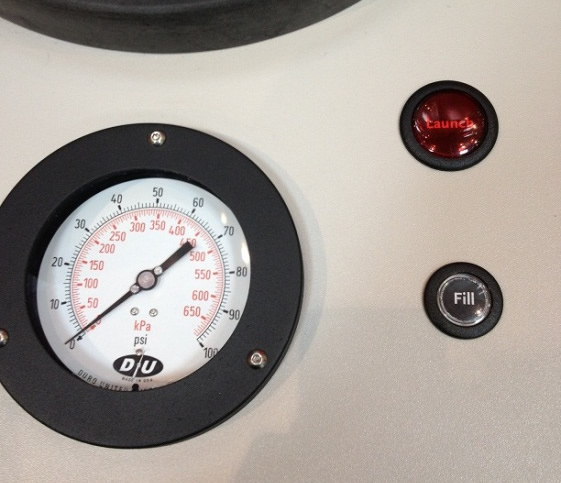
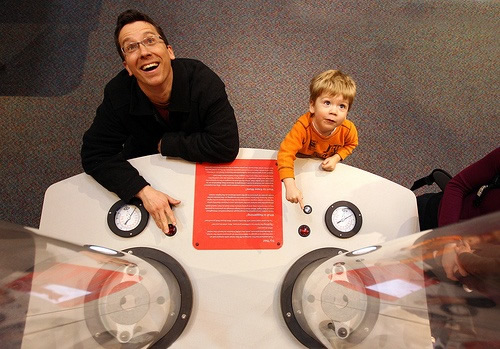
When you push and hold the Fill button, you are filling the rocket with compressed air. As you hold the Fill button, watch the pressure gauge. The pressure gauge needle goes up as the air pressure inside the rocket goes up.
Try this:
- Push and hold the Fill button for one of the rockets.
- Check the pressure gauge to determine the air pressure inside the rocket.
- At the desired pressure, push the Launch button to launch the rocket.
- Watch how fast the rocket launches and how high it goes.
Now repeat the steps (using the same air pressure) with the other rocket.
Did one rocket launch faster and go higher than the other? Why?
These rockets are propelled by escaping gas (compressed air) throughout most of their flight. When there is no longer enough air pressure to provide thrust, the rockets stop and gravity returns them back to their launch pads.
Although the two rockets are the same size, one is heavier than the other. The heavier rocket requires more force to rise the same distance as the lighter rocket. Because the force comes from the escaping air, the heavier rocket needs greater air pressure to go the same distance as the lighter rocket.
What's going on?
When most people think about engines, they think about rotation. For example, a gasoline engine in a car produces rotational energy that turns the wheels which moves the car.
Rocket engines work differently — they are reaction engines. Sir Isaac Newton's third law of motion can help you understand how a rocket engine works. The law states that every action has an equal and opposite reaction. When a rocket's engine expels fuel or propellant downward (the action), the rocket moves upward in the opposite direction (the reaction).
Try this at home!
Here's a simple science experiment you can try to help you understand how a rocket works.
What you'll need:
- 1 balloon (round ones will work, but the longer balloons work best)
- 1 long piece of string (about 10-15 feet long)
- 1 plastic straw
- tape
What you'll do:
- Tie one end of the string to a chair or a door knob.
- Thread the other end of the string through the straw.
- Pull the string tight and tie it to another support in the room (a second chair for example).
- Blow up the balloon, but don't tie it. Pinch the end of the balloon and tape the balloon to the straw as shown below. This step will be easier with two sets of hands — one person pinching the end of the balloon while the other person tapes the balloon to the straw.
- You're ready for launch. Let go and watch your balloon rocket fly!
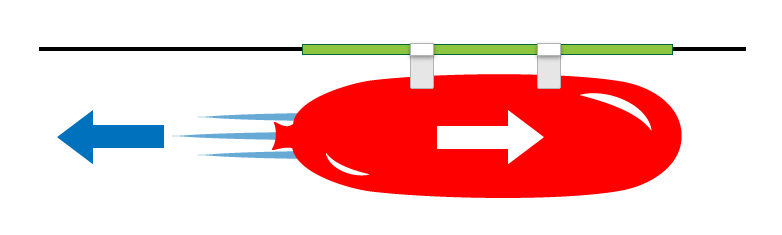
So how does this work? As the air rushes out of the balloon, it creates a forward motion called thrust. Thrust is a pushing force created by energy. In the balloon experiment, the thrust comes from the energy of the balloon forcing the air out. In a real rocket, thrust is created by the force of burning rocket fuel as it blasts from the rockets engine. As the engine's burning fuel blasts down, the rocket goes up! Does this sound familiar?
It's Newton's Third Law of Motion — for every action there is an equal but opposite reaction.
Different sizes and shapes of balloon will create more or less thrust. Try the experiment again using a balloon with a different size or a shape. Does the shape or size of the balloon affect how far (or how fast) it travels?
In the real world
-
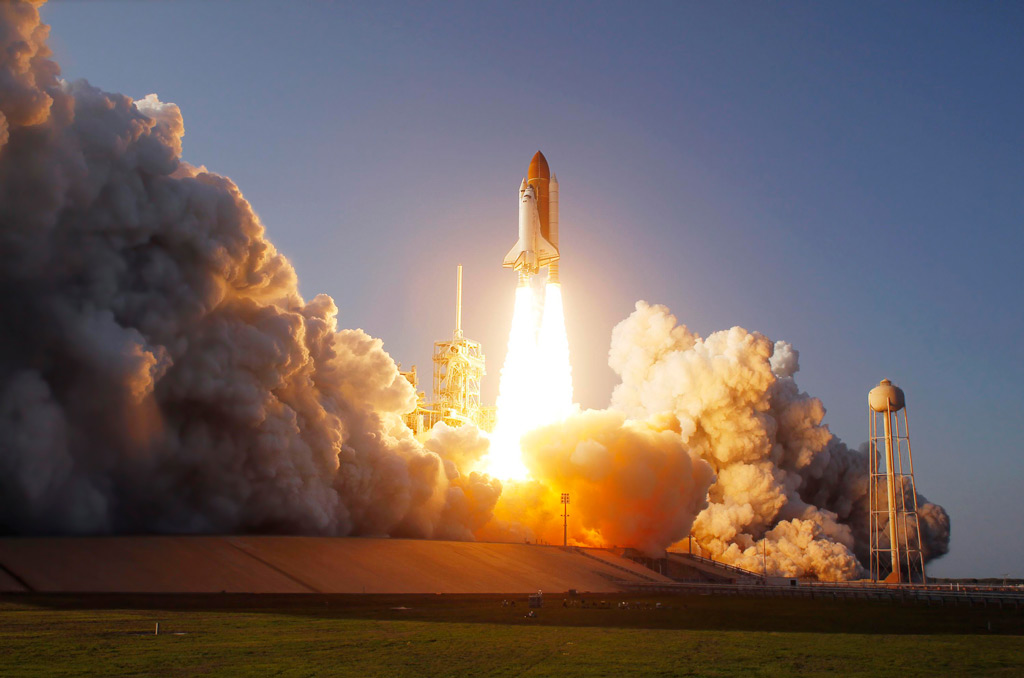
Space travel: Rockets are used to launch space probes that explore the solar system to give us a clearer view of the rest of the universe.
-
Satellites: There are many kinds of satellites (launched by rockets) that affect your life, let's just consider one. Communications satellites allow you to talk to friends on a cell phone and also surf the Internet. Sometimes both at the same time!
-
Military uses: Today's military has smart rockets and missiles that use satellites for guidance.
-
Entertainment: What would the Fourth of July be without fireworks? Developed by the ancient Chinese — fireworks are the oldest and the simplistic form of rocket.
Can't get enough?
We have more about rockets, space exploration, and space science in other exhibits here at the Ann Arbor Hands-On Museum: ViewSpace, Liquid Galaxy, Planetary Gravity and Infrared Light, all on the first floor concourse.